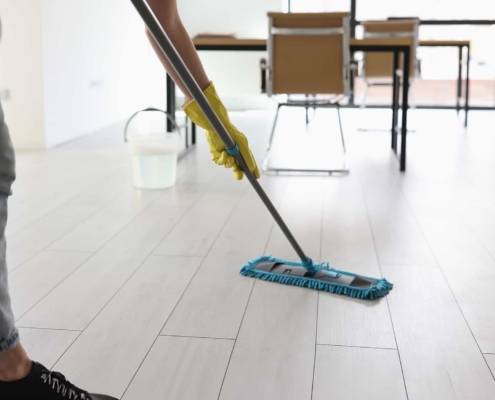
When to Strip, Seal, and Wax VCT Floors in Your Commercial Building

If your floors look dull despite regular mopping, you are not dealing with a cleaning problem — you are dealing with a floor care problem. VCT floor care is a maintenance cycle, not a one-time fix. Vinyl composite tile holds up well in high-traffic commercial environments, but only when it receives the right treatments at the right intervals. Skipping or delaying the strip, seal, and wax cycle costs more in the long run than scheduling it on time.

What the Strip, Seal, and Wax Cycle Actually Does

Most facility managers understand that VCT floors need to be waxed. Fewer understand that waxing alone — applied on top of degraded finish layers — is the reason floors develop that familiar yellowish cast and waxy buildup that mopping never clears.

The cycle works in three distinct steps, and the order matters:

Stripping removes the existing wax and finish layers down to the bare tile. A chemical stripper and a floor machine work the surface clean so new finish bonds directly to the tile rather than to layers of compromised coating.

Sealing applies a base layer that protects the tile and prepares it to hold finish coats. On VCT, sealer fills in the pores of the tile and creates a foundation that extends the life of the wax applied on top.

Waxing — more precisely, applying floor finish — adds the protective, glossy top coat in multiple coats. Quality floor finishes used in California increasingly require low-VOC or zero-VOC formulations to meet California Air Resources Board (CARB) consumer products regulations. Not every commercial cleaning provider uses compliant products, which matters for buildings subject to California’s requirements.

Signs Your VCT Floors Are Overdue for Service

The indicators that it is time to schedule floor stripping and waxing services are usually visible before most facility managers pick up the phone:

  • Floors look yellowed or have developed an orange tint despite regular cleaning
  • Scuff marks and black heel marks will not buff out
  • The surface looks dull or hazy after a thorough clean
  • Finish is peeling or lifting at corners and entry points
  • Tenants or visitors have started commenting on the floor’s appearance

Any one of these signals that the existing finish is breaking down. At that point, buffing alone will not restore the surface — a full strip and wax is the right call.

Buff and Recoat vs. Full Strip and Wax: What Is the Difference?

This is the distinction most online resources skip, and it is the one that most facility managers get wrong.

A buff and recoat is a maintenance procedure. It lightly abrades the existing finish to remove surface scratches and applies one or two fresh coats on top of the current layers. It is faster, less disruptive, and extends the life of the existing finish. Think of it as a tune-up.

A full strip and wax is a restoration procedure. It removes all existing finish coats, seals, and re-waxes from scratch. This is the right call when finish layers are degraded, yellowed, or have accumulated so much buildup that buffing cannot correct the appearance.

For most commercial buildings, a reasonable baseline is a buff and recoat every three to six months and a full strip and wax every twelve to eighteen months — adjusted based on traffic volume and how you use the space.

VCT Maintenance Frequency by Building Type

Traffic patterns determine how quickly floor finish breaks down. A school hallway and a medical office waiting room both have VCT flooring, but they have very different maintenance needs. According to the Resilient Floor Covering Institute (RFCI), maintenance frequency should be tailored to the actual foot traffic and use patterns of each space — not applied as a one-size-fits-all schedule.

Co-working spaces and multi-tenant buildings deserve particular attention. High-turnover, shared-use environments generate inconsistent traffic peaks throughout the day, which accelerates finish wear faster than a single-tenant office with predictable occupancy.

Your VCT Floors Are Telling You Something

If your floors are yellowing, dulling, or showing buildup that mopping cannot touch, the finish cycle is overdue. Quality First Services handles the complete strip, seal, and wax process for commercial facilities across Santa Clara County — using compliant products and staffing every crew with trained, full-time employees. Tell us what your building needs, and we will handle the rest.

How VCT Differs From Other Hard Floor Types

VCT floor maintenance is not interchangeable with other hard floor care, and treating them the same way leads to damage or wasted spend.

Concrete does not absorb wax the way VCT does. Polished concrete requires densifiers, guards, and burnishing rather than finish coats. Applying floor finish to concrete creates adhesion failures that are difficult and costly to reverse.

Natural stone (marble, granite, terrazzo) requires pH-neutral cleaners and stone sealers. The stripping chemicals used on VCT are typically too harsh for polished stone surfaces.

Ceramic tile does not hold floor finish at all. The non-porous glazed surface prevents bonding, so applying wax to ceramic tile creates a slip hazard rather than a protective coat.

If your building has multiple floor types, each needs a separate maintenance protocol. Our floor care services cover VCT, carpet cleaning and shampooing, and other hard surfaces under a single program — so you are not coordinating multiple vendors across the same building.

Frequently Asked Questions About VCT Floor Care

How often should VCT floors be stripped and waxed in a commercial building?

Most commercial buildings benefit from a full strip and wax every twelve to eighteen months, with a buff and recoat every three to six months depending on foot traffic. High-traffic facilities like schools or retail spaces typically need stripping more frequently — as often as every six to nine months.

What is the difference between floor sealing and floor waxing?

Sealer is a base coat applied directly to bare tile after stripping. A professional floor waxing service applies finish on top of the sealer in multiple coats. Skipping or degrading the sealer layer shortens how long the finish holds and causes adhesion problems that show up quickly under heavy foot traffic.

Can VCT floor maintenance be scheduled around business hours?

Yes. Stripping and waxing requires the area to be clear during application and drying. Most commercial facility work is scheduled during evenings or weekends. Quality First Services coordinates timing directly with your team to avoid disrupting building operations.

Do California VOC regulations affect floor care products?

Yes. The California Air Resources Board regulates VOC content in floor waxes and stripping chemicals. Not all vendors use CARB-compliant products. For commercial buildings in Santa Clara County, confirm your floor care contractor is using compliant formulations before you sign a contract.

What happens if VCT floors go too long without a full strip?

Wax layers accumulate and turn yellow, attracting embedded dirt that regular mopping cannot remove. Eventually, finish buildup compromises the tile surface and makes restoration significantly more labor-intensive. At that point, the cost of a full restoration — or tile replacement — far exceeds what routine VCT floor maintenance would have cost over the same period.

Keep Your Floors Clean and Safe With a Reliable Schedule

VCT floor maintenance is the kind of task that gets deferred until the problem becomes visible — and by then, a buff and recoat is no longer enough. Staying on a regular strip, seal, and wax schedule keeps floors looking professional, extends their lifespan, and avoids the higher costs that come with deferred care.

Quality First Services provides floor stripping and waxing for commercial buildings across Santa Clara County and the greater Bay Area. Every crew is made up of full-time, uniformed employees — not temporary labor — and we use low-VOC, compliant products suited to California’s regulatory requirements. Contact us to schedule an assessment and get your floors back on track.

More Like This

Side view of a cleaner mopping a hard floor in office break room