How to Hire the Right Commercial Janitorial Service for Your San Jose Business

Finding a commercial janitorial service in San Jose is easy. Finding one that actually performs — consistently, accountably, and without constant follow-up on your part — is a different challenge entirely. The Bay Area’s commercial market moves fast, and the businesses operating within it carry high standards for how their facilities look, how their employees and clients are received, and how their vendor relationships are managed. A janitorial provider that cannot keep pace with those expectations is not a neutral choice. It is an ongoing operational and reputational liability.

This guide is designed to help facility managers, property managers, and business owners in San Jose and throughout Santa Clara County make a well-informed decision when evaluating commercial cleaning providers. Not every provider is built the same, and the differences that matter most are rarely the ones that show up in a proposal.

Start With Service Scope, Not Price

The first instinct most buyers have when evaluating janitorial services is to compare pricing. That instinct leads to poor decisions more often than it leads to good ones. Price is a meaningful data point, but only after service scope is clearly understood, and most proposals obscure scope rather than clarify it.

A commercial cleaning program for a San Jose office building, multi-tenant property, or corporate campus involves more than nightly vacuuming and restroom maintenance. The right provider should be able to build a service program that accounts for your building type, your occupancy patterns, your industry’s cleanliness standards, and the specific areas of your facility that carry the highest risk of neglect. That means going beyond a standard checklist and understanding what your building actually needs to function well.

For most commercial facilities in Santa Clara County, a complete janitorial program should address routine general cleaning across all common areas and workspaces, dedicated restroom and break room maintenance, high-touch surface protocols that reduce contamination risk, and a defined process for handling areas that require more frequent or specialized attention. Facilities with significant foot traffic, tech campuses, multi-tenant office buildings, medical offices, and co-working spaces, often require daytime support beyond what nightly cleaning alone can sustain. Day porter services fill that gap by keeping common areas, lobbies, restrooms, and shared spaces maintained throughout business hours, responding to spills, restocking supplies, and ensuring the building presents professionally at any point in the day, not just the morning after an overnight crew.

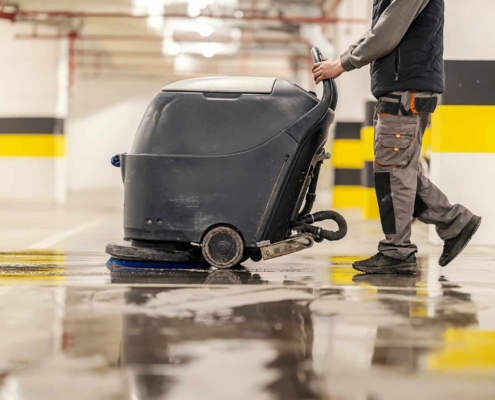
Floor care is another dimension that gets underweighted in early conversations and overweighted in remediation costs later. Hard floor surfaces, whether VCT, LVT, polished concrete, marble, or ceramic, require regular stripping, sealing, waxing, and polishing to maintain both their appearance and their structural integrity. Carpet in high-traffic areas requires periodic deep extraction beyond routine vacuuming to prevent embedded soil from degrading fibers over time. A janitorial provider who treats floor care as an afterthought is a provider who will cost you more in flooring replacement than they ever saved you in contract pricing.


Understand Who Is Actually Doing the Work

This is the question most buyers never think to ask and the one that matters more than almost any other. When you hire a commercial cleaning company, are you hiring their employees, or are you hiring a company that will subcontract your building to a third party whose training, vetting, and accountability standards you have no visibility into?

Subcontracting is widespread in the commercial cleaning industry and is rarely disclosed proactively. It means the crew that shows up to clean your building may have no direct relationship with the company you signed a contract with, no facility-specific training, and no accountability to the service standards you negotiated. When issues arise, the response chain becomes complicated in ways that are difficult to resolve cleanly.

The alternative is a provider whose entire team is hired, trained, and supervised in-house. This model produces meaningfully better outcomes: crew members develop familiarity with your specific building, its layout, its high-traffic windows, and its recurring problem areas. That institutional knowledge translates into cleaning that is more consistent, more anticipatory, and more responsive than what a rotating pool of unfamiliar subcontractors can deliver. When evaluating any provider, ask directly whether the people cleaning your building will be the company’s own employees and whether that is documented in the service agreement.

Evaluate the Accountability Structure, Not Just the Promises

Every commercial cleaning company will tell you their service is consistent and their team is professional. The question is not what they claim. It is what systems they have in place to verify those claims and what happens when performance falls short.

A provider with a real accountability structure will have supervisory oversight built into every service visit, not as an occasional audit but as a standard operating procedure. They will conduct regular quality inspections of the facility and provide written documentation of findings. They will have a defined communication process for raising issues, requesting service adjustments, and receiving confirmation that problems have been resolved. And they will have the ability to respond in real time, not 24 hours after the fact, when something unexpected happens in your building during business hours.

Monthly quality reporting is one of the clearest signals that a provider is serious about accountability. A written summary of what was inspected, what was found, and what was addressed gives you a documented record of service performance over time. That record is useful in its own right and invaluable in situations where tenant complaints, lease disputes, or liability questions require documentation of facility maintenance history.

The providers who cannot offer these accountability mechanisms are not hiding it because they are trying to deceive you. They often simply do not have the operational infrastructure to deliver it. That gap shows up in the buildings they service within the first 90 days, long before the initial contract term is up.

Ready to hold your next provider to a higher standard? Schedule a complimentary onsite assessment with Quality First Services today. 

Consider Whether Green Cleaning Standards Matter for Your Facility

In Santa Clara County, where environmental values are embedded in the culture of both the businesses operating here and the workforce those businesses employ, green cleaning is increasingly less of a preference and more of an expectation. Employees notice the products being used in their environment. Tenants notice. Clients notice. And in regulated industries like healthcare and life sciences, the chemical exposure implications of cleaning product selection carry compliance weight, not just cultural weight.

A provider committed to green cleaning uses products formulated to reduce volatile organic compound exposure, minimize chemical residue on surfaces, and avoid the respiratory and skin irritants that conventional cleaning agents introduce into enclosed commercial spaces. This matters most in facilities where people spend significant portions of their day, including offices, medical buildings, laboratories, and educational environments, and in buildings with sensitive ventilation systems where chemical residue circulates broadly.

When evaluating a provider’s green cleaning practices, look for specificity rather than general claims. Ask which product lines they use, how product selection is determined for different surface types and environments, and whether staff are trained on proper application, ventilation requirements, and product storage. A provider who can answer those questions with precision is a provider who actually operates to a green standard. A provider who answers with marketing language is not.

Look Beyond Cleaning to Integrated Facility Support

One of the most significant inefficiencies in commercial building management is vendor fragmentation, which means using separate providers for janitorial services, floor care, exterior cleaning, and facility maintenance while spending meaningful time and energy managing the coordination gaps between them. When a maintenance issue is discovered during a cleaning visit, who owns it? When a floor care problem develops that requires both cleaning and repair work, which vendor is responsible? When something falls between services, who takes the call?

A provider who can deliver commercial cleaning, hard floor care, exterior cleaning including pressure washing, and facility maintenance under a single relationship eliminates those gaps and reduces the administrative overhead of building management in a meaningful way. For property managers overseeing multiple buildings in Santa Clara County, that consolidation has compounding value, including fewer contracts, fewer points of contact, fewer coordination failures, and a single provider with enough visibility into the building to identify and flag issues before they become expensive problems.

Facility maintenance capabilities vary significantly between providers. A company with licensed technicians, general contractor credentials, and experience in preventive maintenance inspections is a fundamentally different partner than a cleaning company that offers to change light bulbs. When evaluating a provider’s maintenance capabilities, ask about the scope of services they can perform in-house, whether they carry the appropriate licensing and insurance for that work, and how maintenance findings are documented and communicated.

Verify Insurance, Licensing, and Reference Quality

No evaluation process is complete without confirming that a provider carries adequate general liability and workers’ compensation insurance for commercial cleaning operations in California, and that their coverage extends to the full scope of services they are performing in your facility. This is not a formality. An uninsured or underinsured provider creates direct exposure for your business in the event of property damage, a workplace injury, or a liability claim arising from a service incident on your premises.

Beyond insurance, ask for references from businesses in San Jose or Santa Clara County that are similar to yours in terms of industry, building type, and size. A provider with genuine local experience in your sector will be able to produce those references readily. A provider who struggles to provide relevant references is a provider whose local and industry-specific experience may not match what their sales presentation implies.

Pay attention to how long the references have been with the provider and whether the relationship has expanded over time. Long-term client relationships in commercial cleaning are a strong signal of consistent performance. Businesses do not maintain multi-year cleaning contracts with providers who are not delivering.

What the Right Provider Relationship Actually Looks Like

The goal of this evaluation process is not to find the least expensive janitorial option that meets a minimum acceptable standard. The goal is to find a provider whose operational model, accountability structure, and service capabilities make your building easier to manage over the long term, not harder.

The right janitorial partner for a San Jose business proactively identifies supply issues before restrooms run out of product, flags maintenance problems before they become repair expenses, communicates in real time when something unexpected requires attention, and delivers a building that reflects the professional standards of the business operating inside it. That kind of partnership does not happen by accident. It is the product of an operational model built around accountability, dedicated in-house staffing, and a genuine understanding of what commercial facilities in this market actually require.

If you are in the process of evaluating janitorial providers for your Santa Clara County facility, the questions and criteria in this guide are the right starting point. The provider who can answer them clearly, completely, and with documentation to support their claims is the provider worth a serious conversation.

Quality First Services has served commercial facilities throughout San Jose and Santa Clara County for over 25 years. To schedule an onsite assessment and discuss what a high-accountability cleaning and maintenance program looks like for your specific facility, contact our team directly or submit a service request through our website.

More Like This

Quality-First-Services-Inc-Inbound-SDR-December-2025-Blog-1-What-Makes-a-Janitorial-Service-‘Professional_-7-Signs-1